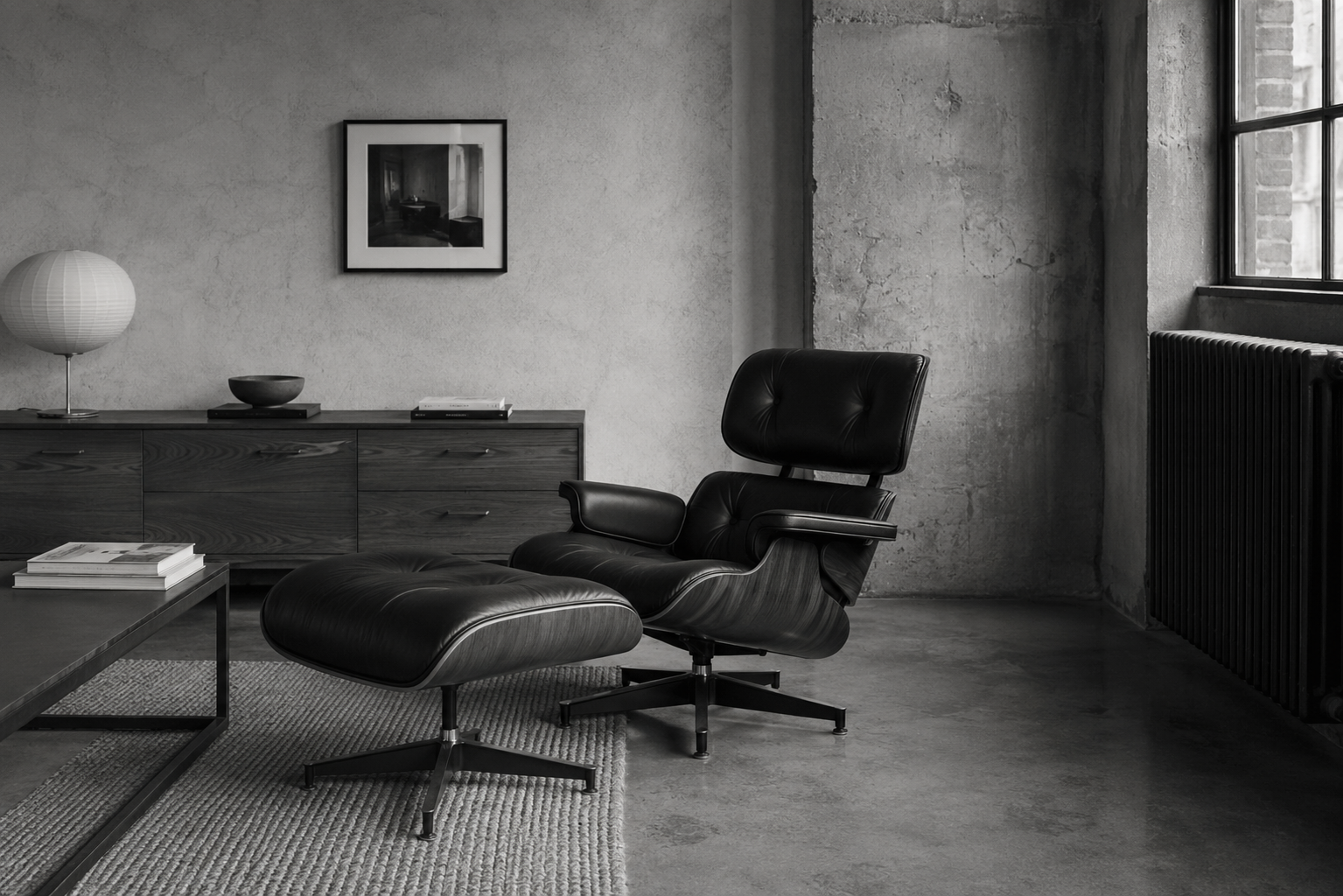
Eames furniture is everywhere in West London, but it rarely reads as design any more.
You see it in renovated Victorian houses in Chiswick, Notting Hill, Brook Green, and parts of Hammersmith. In a familiar version of the room, pale timber runs through to a black-framed rear extension, a stone island holds almost nothing, and the chair sits just off-centre, angled enough to be noticed but not enough to disturb the composition.
In architecture studios, boutique hotels, co-working spaces, private clinics, and cafés, the same interior language appears repeatedly: softened period light, brushed metal fixtures, open shelving, controlled neutrality, and enough empty space to imply restraint rather than absence.
The chair is rarely the point of the room.
It is often placed slightly too carefully: not pushed fully into use, but held in visibility. Close enough to suggest ease, far enough from daily clutter to remain composed.
More often it sits quietly within a larger renovation formula that has become increasingly familiar over the last fifteen years. Architectural lighting. Neutral stone. One wall left deliberately sparse. A few design objects arranged carefully enough to imply judgement rather than enthusiasm.
Within that environment, the Eames chair no longer functions as an object that stands out. It functions as an object that settles things.
What it signals is not modernism, or even taste in any active sense, but recognition: an immediate cultural reassurance that tells you what kind of interior you are in before anything else in the room has to speak.
This marks a significant shift from the furniture’s original context. Charles and Ray Eames were working within a mid-century American design culture shaped by post-war production, industrial optimism, and the belief that design could reorganise everyday life. Their work was tied to systems: ergonomics, affordability, mass manufacture, and the idea that modernity should be lived rather than staged.
That intent is rarely what the furniture communicates in contemporary settings.
In West London, Eames has been absorbed into a different logic entirely, one shaped less by ideology than by the culture of domestic renovation. Interiors are often produced with one eye on property value, photographic coherence, and a version of timelessness built from muted materials and low visual risk. Even expensive rooms can be surprisingly cautious.
In that setting, Eames becomes useful for different reasons. Estate agents recognise it as reassurance: evidence that a space already belongs to an established language of value. Architects use it because it resolves rooms quickly without creating visual friction. Hospitality interiors rely on it for similar reasons. It circulates easily because it no longer requires explanation.
The object succeeds not because it stands apart from the surrounding environment, but because it helps the environment stabilise itself.
You can see this clearly in places like The Old Cinema in Chiswick, where mid-century furniture, industrial salvage, oversized lighting, and decorative fragments are staged together under one roof. A chair might sit beside metal lockers, a brass floor lamp, or a table from another decade entirely — not as a period arrangement, but as part of a familiar visual language.
At a certain point, taste becomes infrastructural.
Eames fits this condition almost too well. It does not interrupt the room. It stabilises it.
That stabilising function is probably why it survives. Many modernist objects retain too much historical atmosphere; they become overly declarative when placed in contemporary interiors. Eames, by contrast, has become light enough to move across contexts without insisting on its own origin story.
In West London, this adaptability is decisive. So much of the area’s interior culture is built on repetition — a shared vocabulary of neutral tones, softened industrial detailing, and controlled restraint repeated across neighbourhoods and property types. Within that repetition, objects are less individual statements than elements within a larger system.
What matters is less the object itself than the ease with which it fits the surrounding environment.
Eames works because it already knows how to behave.
And yet the paradox remains: the furniture is still good. The proportions are still precise. It still solves spatial problems with an ease that many contemporary attempts at “timeless” furniture fail to achieve. It still sits lightly inside rooms already doing a great deal of aesthetic work.
Which is why the story is not simply one of modernism being absorbed into affluent domestic taste. It is also about a small number of objects that survive precisely because they can survive absorption without being emptied entirely.
In West London, Eames no longer operates as a sign of modernism, or even of design literacy.
Instead, it has become part of the infrastructure of settled taste, helping contemporary interiors feel immediately recognisable without ever drawing attention to itself.